
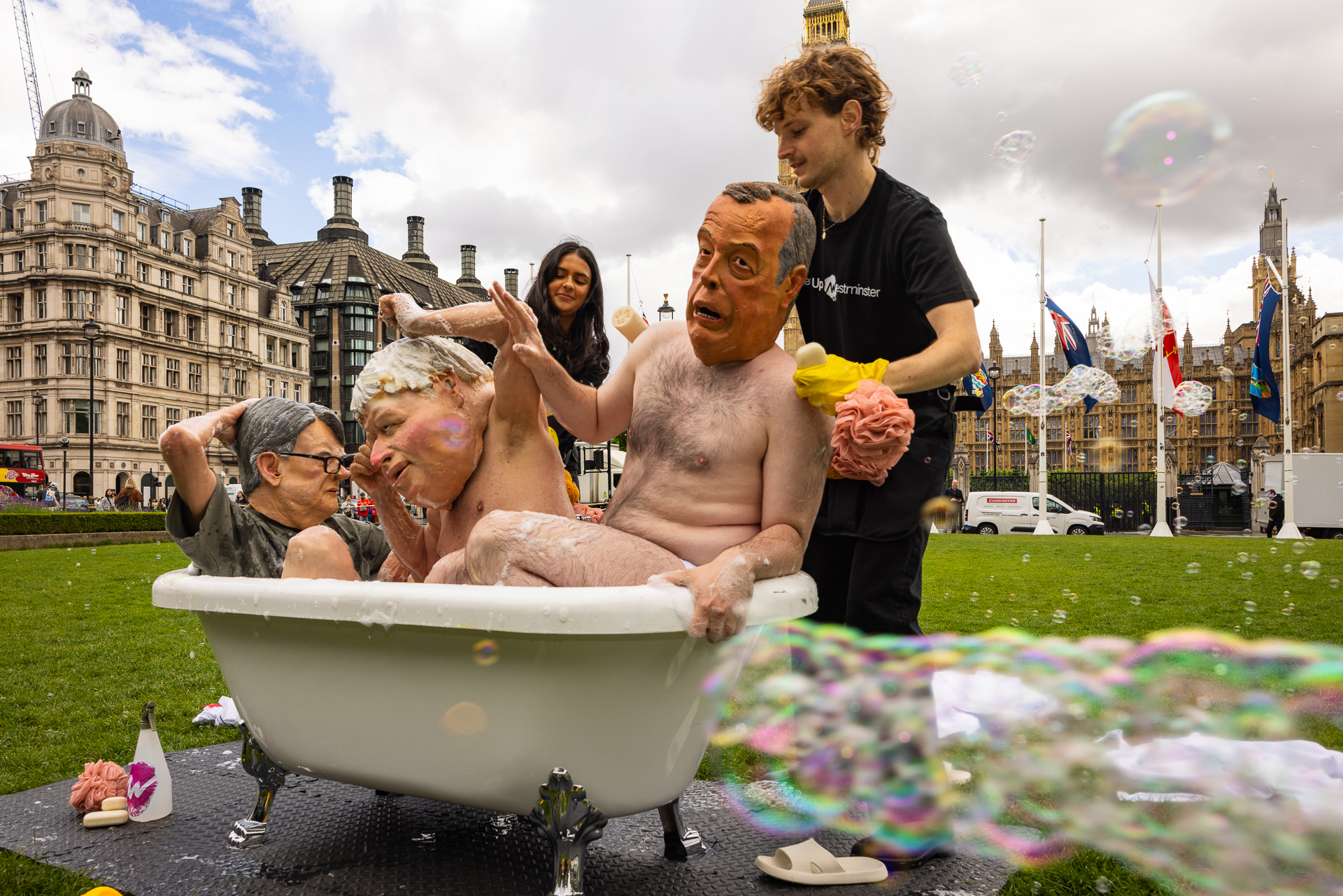
This article originally appeared in The Express.
By: Olly Buston, Director at Clean Up Westminster.
OPINION – Olly Buston: Andy Burnham must root out corruption from political donations.
It’s back to business for politicians as Parliament resumes after the long summer recess. And business – namely the corrosive influence of big money in politics – is very much on the mind of worried constituents.
When speaking with people in Clacton this summer, I asked what word they would use to best describe UK politics: their most frequent answer was “dirty”. Many pointed to the huge sums of money infiltrating political parties as evidence that our democracy is now rigged against British people.
This idea was brought to the fore by the £5million gifted to Nigel Farage by the overseas crypto-billionaire Christopher Harborne, and support provided to Reform by convicted fraudster George Cottrell.
But we should not be fooled into thinking that this is an issue for just one party. Reform has exposed a much bigger problem: we are now in the middle of an arms race with every party trying to attract ever larger donations from ever richer individuals.
You would have to have the gullibility of a puppy to think these mega donors don’t want anything in return. Nobody believes that.
The people I spoke to in Clacton were not interested in the finer points of party funding law. They were interested in whether politicians were playing by the same rules as everyone else.
That matters because as soon as people believe money buys influence, trust in the whole political system vanishes. It also feeds the sense that politics is something done to people rather than something they have a stake in. And this is why the problem goes beyond Reform. The corrosive influence of big money has been allowed to take root across many parties.
For voters who already feel politics is rigged in favour of people at the top, the sight of politicians taking huge sums from wealthy individuals only reinforces that suspicion. It’s a vicious circle: the more money dominates politics, the less ordinary voters feel their voices matter.
Under the Conservative government it became increasingly clear that money could buy access and influence. One of the more absurd examples was when the wife of oligarch and former Russian deputy finance minister Vladimir Chernukhin paid £160,000 to play tennis with Boris Johnson.
The Conservatives made cash for peerages the norm. We are a country where you can buy a seat in our parliament from where you can shape the laws of the land.
Politicians from the left can have a blind spot too. Because they genuinely believe they are trying to make the world a better place, they sometimes seem to think they are above corruption. The “freebie gate” scandal of free spectacles, tickets and clothes for Keir Starmer and his top team involved nowhere near the scale of the gifts made by Reform’s mega donors. But it was grubby and it knocked the government off course very early in its reign and was where the rot set in.
Andy Burnham must not make the same mistake in his first 100 days. He must be above corruption. And he hasa historic opportunity to clean up Westminster and reduce the dangerous impact of big money on our democracy when the Representation of the People Bill returns to Parliament this week.
Keir Starmer proposed a cap on overseas based donors, but not one on UK based donors. This made little sense. It is surely not much better for a billionaire based in this country to be undermining our democracy than a billionaire based in Thailand.
Burnham must introduce a hard and low cap on all political donations. This would be wildly popular, with 92% of British voters supporting such a cap, according to a recent Fair Vote UK poll. It would also be the right thing to do.
A cap wouldn’t stop anyone giving to a party or supporting the political causes they believe in. It would simply stop a handful of very wealthy people from being able to buy outsized influence over our politics.
Parties should be fighting to win support from voters, not spending their time cultivating relationships with the wealthiest people they can find.
In the end, it comes down to a pretty simple principle that has been forgotten: in a democracy, political influence should come from the arguments you make and the people you can persuade, not the size of your bank balance.